
Awakened… Now What?
The Integration Crisis No One Talks About


The Modern Obsession With Awakening
It seems as if everyone is captivated by the idea of awakening. In podcasts, retreats, meditation studios, and bestselling books, the promise of expanded consciousness appears to be the ultimate achievement of personal growth.
People long to see beyond the illusions of identity and separation, to touch a deeper truth about reality, and to experience what mystics across centuries have described as unity, presence, or nonduality. Myself included.
The pursuit of awakening has become not only a spiritual aspiration but also a cultural phenomenon. According to the Global Wellness Institute, the wellness industry now exceeds $5 trillion globally, and a significant portion of that economy is fueled by the promise that individuals can transcend ordinary consciousness and access something more profound.
Yet, a deeper question remains: what happens after awakening?
When Awakening Becomes A Cultural Story
I was reminded of this question while watching the television series Search Party, a dark comedy that begins with a seemingly straightforward premise. A group of twenty-somethings in Brooklyn (shout out to my birthplace and where I completed residency) sets out to find a missing former classmate. What initially looks like a well-intentioned rescue mission quickly evolves into a complicated exploration of identity, morality, and meaning among young adults navigating the confusion of modern life.
Over five seasons, the characters move from searching for purpose to concealing a murder, facing a sensational trial, and eventually witnessing the transformation of their friend Dory into an unlikely spiritual figure after she experiences a near-death event that she interprets as enlightenment.
Her awakening becomes the center of a movement. The series culminates in the creation of a pill designed to deliver instant enlightenment to the masses. This intentional (and ridiculously hilarious) series illustrates how easily spiritual insight can be commodified and how quickly followers can gather around someone who appears to have touched a deeper truth. The story does not end well, and the outcome offers a cautionary tale about the consequences of treating awakening as a product rather than a process.
The Peak Experience Problem
Although the show exaggerates for comedic effect, the underlying insight is not far removed from reality. Modern culture increasingly treats awakening as an endpoint rather than a threshold. People chase peak experiences through breathwork, psychedelic therapy, meditation intensives, or immersive retreats in the hope that a single breakthrough will dissolve suffering and reveal permanent clarity.
I am these people and I can admit that these experiences can be transformative and meaningful. Neuroscience research on meditation and psychedelics states that altered states of consciousness can temporarily reduce activity in the brain’s default mode network, a neural system associated with self-referential thinking and duality. When this network quiets, individuals often report feeling unity, expanded awareness, and a loosening of the boundaries that typically define the sense of self.
The experience can be extraordinary. But, as I can attest, the challenge begins afterward.
After The Ecstasy
In this influential book that I’m currently listening to, After the Ecstasy, the Laundry, meditation teacher Jack Kornfield describes a phenomenon familiar to anyone who has tasted profound spiritual insight. Moments of clarity do not eliminate the ordinary responsibilities of life. Bills still need to be paid. Relationships still require patience. The body still ages and demands care. Kornfield writes that many practitioners feel a surprising sense of disorientation after their most powerful breakthroughs because the world appears unchanged even though their perception has shifted. Enlightenment, in other words, does not exempt anyone from the laundry.
The Parachute Moment
I encountered a version of this realization during one of the most profound experiences of my life a few weeks ago that had nothing to do with meditation cushions. It happened while skydiving.
The ascent to fifteen thousand feet created a strange mixture of anticipation and dread as the aircraft climbed higher and the ground receded into abstraction. When the moment came to jump, my fear dissolved into an unexpected clarity that arrived the instant my body left the plane. For a brief period into the sixty second free fall, the usual mental chatter disappeared. There was no past, no future, and no identity to defend. Awareness felt immediate and expansive, as if the sky itself had replaced the usual boundaries of thought. I’m sure the 200 km/hr fall had something to do with it.
Then the parachute opened.
The sudden deceleration marked the transition from peak experience to re-entry. The earth, which had momentarily disappeared beneath the horizon, came back into view. The most intense moment of the experience had already passed, yet the journey was far from over. I was not finished. I was still descending.
That descent, I feel, is a powerful metaphor for awakening itself. The moment of realization resembles the jump from the plane. It is exhilarating, destabilizing, and transformative. Yet the remainder of the journey involves learning how to land and how to walk again on the ground.
The Map Hidden in Zen
Long before the wellness industry discovered enlightenment as a marketing strategy, Zen Buddhism developed a visual teaching that captures this process with remarkable precision. The Ten Ox-Herding Pictures, a series of illustrations dating back to the twelfth century, depict the spiritual journey as a search for an ox representing the true nature of mind. The early stages portray a seeker wandering through confusion before discovering traces of the animal’s footprints. Later images show glimpses of the ox itself and the struggle to catch and tame it.
What surprises many people seeking enlightenment, is that awakening occurs less than halfway through the sequence.
The final images do not depict transcendence or escape from the world. Instead they show the practitioner returning to ordinary life. In the tenth and final picture, the awakened individual enters the marketplace with open hands, laughing and engaging with others.
Enlightenment is therefore, not a permanent retreat from society. It is a deeper participation in it.
Ten Ox-Herding Stages of Awakening
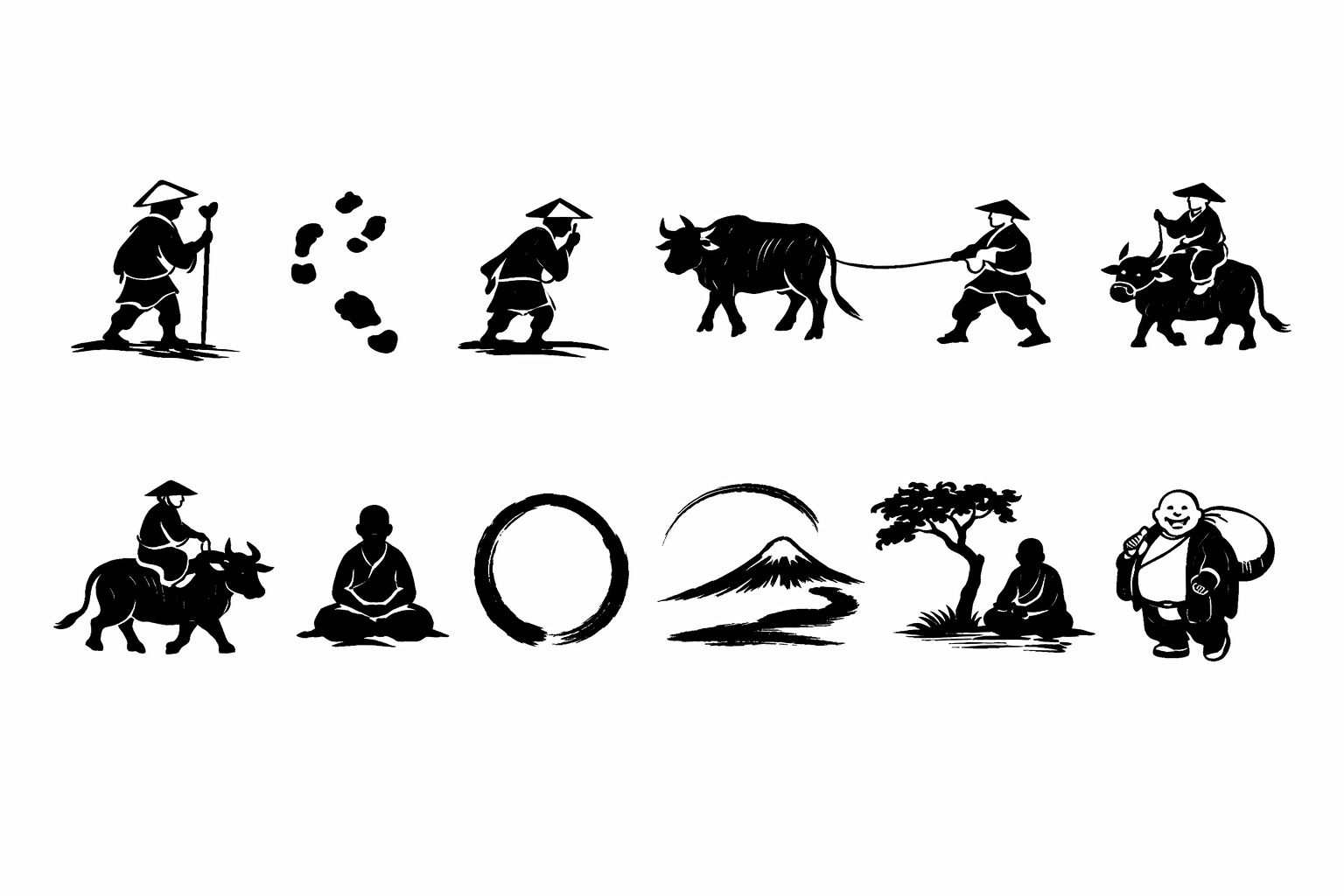
Searching for the Ox – sensing that something is missing
Seeing the Footprints – first signs of truth appear
Seeing the Ox – the first direct awakening experience
Catching the Ox – struggling to grasp and understand the insight
Taming the Ox – stabilizing awareness through practice
Riding the Ox Home – harmony between the seeker and truth
Ox Forgotten, Self Alone – the search dissolves
Both Ox and Self Forgotten – emptiness and nonduality
Returning to the Source – ordinary life becomes sacred
Entering the Marketplace – returning to the world to serve
Where Most Of Us Are
This perspective challenges a common misunderstanding within the modern spiritual culture and wellness industry. Awakening is often framed as the ultimate destination, and the moment when illusion falls away and clarity replaces confusion. The Zen tradition suggests something different. Awakening marks the beginning of integration rather than the end of the path.
Most people today appear to be navigating the early stages of this journey. The widespread interest in meditation, mindfulness, and consciousness exploration reflects a growing sense that something about modern life feels incomplete. Many of you may sense the footprints of the ox and occasionally glimpse it directly through powerful experiences. The wellness industry thrives on this desire by offering workshops, retreats, and tools designed to accelerate the process.
Integration Is The Real Work
There is nothing inherently wrong with that search. The problem emerges when awakening is treated as a commodity rather than a transformation that unfolds over time. Without integration, profound insights can produce confusion rather than clarity. Individuals may begin to see themselves as separate from those who have not had similar experiences, creating a subtle form of spiritual superiority that replaces the very ego awakening was meant to dissolve.
The deeper lesson of the ox-herding metaphor is that awakening must eventually lead back to ordinary life. The marketplace remains the final destination because the purpose of insight is not escape but participation. Awareness expands so that compassion can expand with it. Read that twice.
Returning To The Marketplace
In a culture fascinated with peak experiences, this message may be pretty radical. Enlightenment does not remove anyone from the human condition. It invites them to inhabit it more fully.
The jump may be dramatic, but the landing is where life continues.
For those exploring your own path, the most useful question may not be whether your awakening has occurred either in near death, extreme trauma, deep meditation or a “natural” substance. A more useful question is how is your awakening shaping your daily choices, relationships, and responsibilities?
Insight becomes meaningful when it changes the way a person lives day to day.
The journey does not end with ecstasy.
After the ecstasy, there is still the laundry.
Now What?
If this reflection resonates with you, consider where you might be on the journey. Are you searching, glimpsing, integrating, or returning to the marketplace?
Personally, I’m between stages 4, 5 and 6 depending on the season.
Remember that awakening is not a race and integration cannot be rushed. The path unfolds through experience, humility, and the willingness to keep showing up for life as it is.
The most meaningful spiritual work is not in chasing extraordinary experiences but in learning how to live your ordinary life with extraordinary awareness.
Wherever you are in your journey, trust that you are allowed to meet life at your own pace. Here’s to your post-awakening integration.
— Dr. Natacha
Selected References
Kornfield, J. (2000). After the Ecstasy, the Laundry: How the Heart Grows Wise on the Spiritual Path. Bantam.
Global Wellness Institute (2023). Global Wellness Economy Report.
Suzuki, D. T. (1960). Zen Buddhism: Selected Writings. Doubleday.
Austin, J. H. (1998). Zen and the Brain: Toward an Understanding of Meditation and Consciousness. MIT Press.
Carhart-Harris, R. et al. (2014). Neural correlates of psychedelic states. Frontiers in Human Neuroscience.